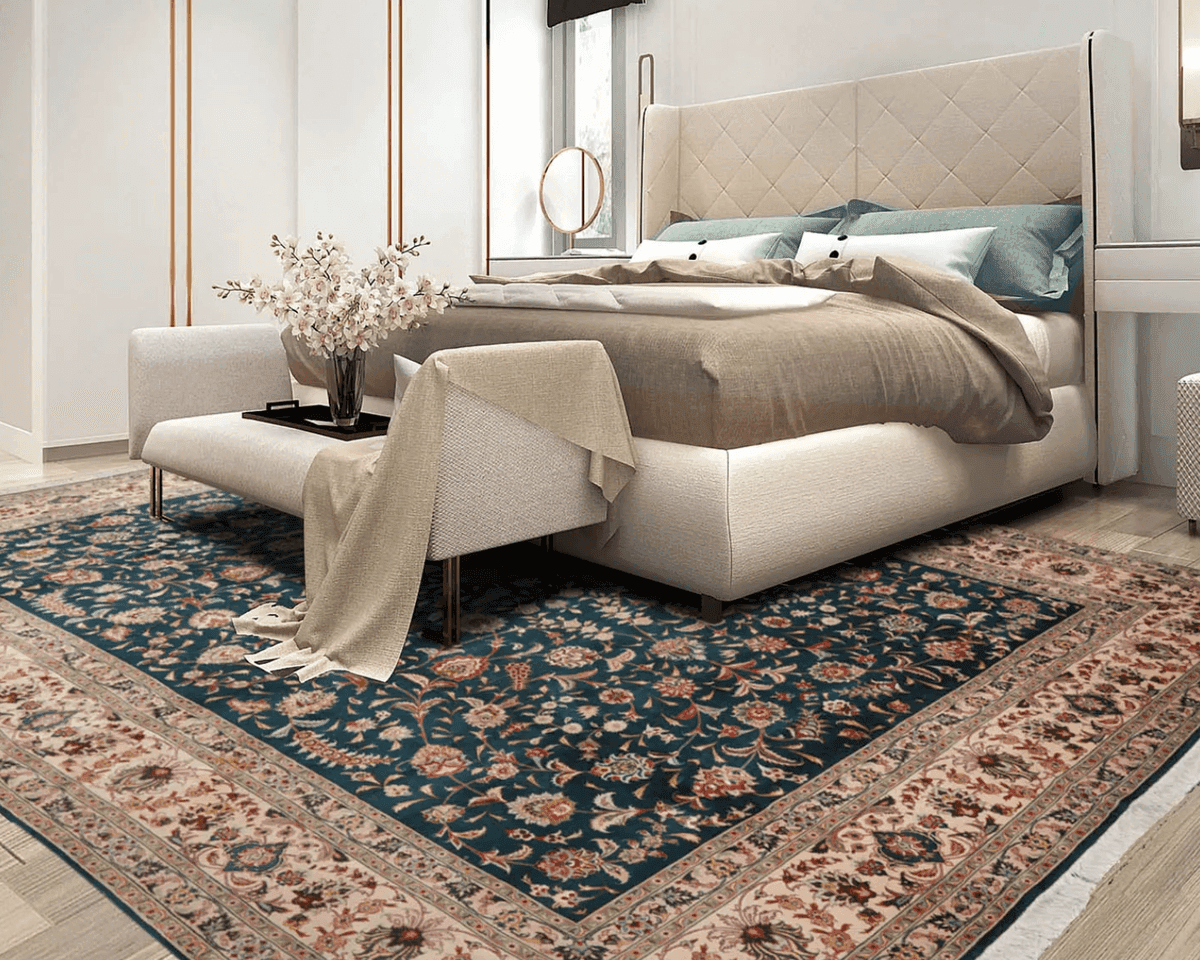
Oriental rug cleaning in Evans, GA is different from regular carpet work, and it deserves a careful hand. A good Persian, Turkish, or Caucasian rug can be worth more than the sofa it sits next to. Sometimes more than the car in the garage. The dyes, the knots, and the foundation all react to moisture in ways that machine-made rugs don't, and the wrong cleaning approach can cause damage that's expensive or impossible to reverse.
We clean oriental rugs in your home using a carbonated, chemical-free method that's gentle on the fibers, the foundation, and the dyes. No harsh detergents, no steam, no flooding the rug with water. For most rugs, this is enough to bring back the color depth and get the fine grit out of the foundation. For rugs that genuinely need a full submerge wash in a plant, we'll tell you that upfront and won't try to do the job halfway.
The honest answer for most households is that in-home cleaning handles 80% of what their oriental rug actually needs. The rest is mostly a question of how old, how valuable, and how much foot traffic the rug is seeing.
Our 6-step oriental rug cleaning process
Every rug gets the same sequence, adjusted for what we find during the inspection.
1. Rug assessment and fiber identification
We start by looking at the rug before anything gets wet. We flip it over, check the knot structure, look at the foundation for dry rot or weakness, examine the fringe for damage, and identify what the rug is actually made of. Wool, silk, cotton, jute, nylon, olefin, and various synthetic blends all behave differently when you introduce moisture and cleaning solution.
We also test the dyes in a discreet corner. If a dye is going to bleed, it'll usually bleed on contact with plain water, and that's something we want to know before we start, not halfway through a cleaning pass. Some older Persian rugs use vegetable dyes that are more prone to running. Some newer rugs from certain regions use synthetic dyes that are practically bulletproof. We figure out which situation we're in before we proceed.
2. Pre-treatment and dusting
This is the most important step on an older rug and the one that gets skipped most often. A hand-knotted wool rug that's been on the floor for five years is holding a surprising amount of grit deep in the foundation. That grit is what cuts the wool fibers from the inside every time someone walks across it. Getting it out extends the rug's life by years.
We dust thoroughly, then pre-treat any visible stains, pet spots, or areas of heavy soil. The pre-treatment solution is wool-safe and approved for use on natural fibers. It loosens embedded soil so the main cleaning pass can actually reach it.
3. Deep cleaning with carbonated, chemical-free solution
Here's where our method really differs from steam cleaning or traditional shampooing. We use a carbonated cleaning solution. The carbonation creates millions of tiny bubbles that lift dirt and oils to the surface without saturating the rug's foundation. Think of it like club soda lifting a stain out of a shirt, but much more controlled.
No harsh chemicals. No detergent residue left behind to attract new dirt. No soaking the backing or the cotton warp threads. We work with the pile direction, not against it, which matters more than most people realize on a hand-knotted rug where the pile has a natural lean.
4. Spot and odor treatment
Any stains that didn't respond fully to the pre-treatment get individual attention here. Pet odors, food stains, wine, and the yellowing that happens on rugs near sunny windows all get different treatments.
If you've got a pet odor problem that goes beyond the surface, we'll tell you. Surface odor on a rug is treatable. Urine that's soaked through to the foundation is a bigger conversation, and it may need the kind of treatment we do through our pet odor service or, in some cases, a plant wash.
5. Rinse and fast drying
We rinse the rug to make sure there's zero residue left in the fibers. Residue is the enemy of a good cleaning job on any textile, but it's worse on oriental rugs because it attracts new soil faster and can dull the colors over time.
Because we're using a low-moisture method, drying time is a fraction of what you'd get with steam cleaning. Most rugs are dry within a few hours. You're not living without your rug for days while it air-dries in a garage.
6. Grooming and final inspection
We groom the pile back into its natural direction and do a final inspection with you. We'll point out anything we noticed during the process: areas of wear, moth damage that became more visible once the dirt lifted, fringe that's starting to deteriorate, or previous cleaning attempts that left residue or caused issues.
If anything needs follow-up work that's beyond what we do, like hand fringe repair or structural restoration, we'll tell you and point you in the right direction.
Fiber types and rug styles we clean
Wool rugs
Wool is the most common fiber in hand-knotted oriental rugs and it's the most forgiving to clean, within reason. Wool is naturally stain-resistant, holds dye well, and bounces back from compression. Our wool-safe approved solutions are formulated specifically to clean wool without stripping its natural lanolin or causing fiber damage.
Silk and silk-blend rugs
Silk is beautiful and fragile. It stains more easily than wool, it's more sensitive to moisture, and it doesn't tolerate agitation the way wool does. We adjust our approach significantly for silk rugs. Some silk rugs are better candidates for plant cleaning, and we'll tell you if that's the case with yours.
Cotton rugs
Cotton foundations are common in many Persian and Indian rugs. Cotton absorbs more water than wool, which is why low-moisture cleaning matters. A cotton foundation that stays wet too long can shrink, buckle, or develop mildew.
Synthetic and blended fibers
Nylon, olefin, and polyester rugs styled to look like orientals are increasingly common. They're easier to clean and more forgiving of mistakes. The cleaning still matters since synthetics hold body oils and pet dander just as well as natural fibers, but the risk of damage is lower.
Jute-backed rugs
Jute doesn't love moisture. Period. We use an even drier method on jute-backed rugs and we're honest about the limitations. If you've got a jute rug with a deep stain, the results may be partial.
Rugs we commonly clean in the Augusta metro
- Persian rugs (Kerman, Tabriz, Isfahan, Bijar, Heriz, Sarouk, and others)
- Turkish and Anatolian rugs
- Caucasian and Kazak-style rugs
- Indian and Pakistani wool rugs
- Chinese silk and silk-blend rugs (case by case)
- Contemporary hand-knotted wool
- Machine-made oriental-style rugs
If you're not sure what you have, the knot count on the back, the dye style, and the fringe construction tell us most of what we need to know. Bring your questions when we arrive. We like talking about rugs.
In-home vs. in-plant cleaning
Most oriental rugs in Evans homes get cleaned in-home, and most of them do great with that approach. In-home is faster, less disruptive, and you can watch the process. You're not hauling a heavy rug to your car and waiting a week to get it back.
In-plant cleaning (submerge washing) is the better choice when:
- The rug has deep, saturated pet urine in the foundation
- There's significant moth damage that needs full immersion treatment
- The rug is extremely valuable and you want the most controlled environment possible
- The foundation is fragile enough that any moisture needs to be carefully managed in a flat-dry setting
We'll give you our honest recommendation. We don't push in-plant when in-home will do the job, and we don't push in-home when the rug really needs more.
Why custom cleaning matters for oriental rugs
Not every oriental rug gets the same treatment. A thick, tightly-knotted Bijar can handle more moisture and agitation than a loosely-woven Kilim. A rug with natural vegetable dyes needs more careful testing than one with stable synthetic dyes. A silk Hereke is a completely different animal than a cotton-foundation Dhurrie.
We adjust our approach based on the knot structure, the fiber content, the dye stability, and the condition of the rug. That assessment step at the beginning isn't a formality. It's how we avoid causing the kind of damage that keeps rug repair shops busy.
What we'll flag before we start
- Any dry rot or foundation weakness
- Dyes that aren't colorfast
- Moth damage that we might make more visible once the dust lifts
- Previous cleaning attempts that used too much water or the wrong solution
- Fringe that's starting to separate or deteriorate
We'd rather have a short conversation before we start than a difficult one after.
Protecting the rug between cleanings
A rug pad makes a bigger difference than most people realize. It keeps the rug from sliding, protects the foundation from abrasion on the hard floor underneath, and lets the fibers recover between foot traffic. If you don't have a pad, ask us about it when we're there.
Vacuum in the direction of the pile, not against it, and rotate the rug once or twice a year so the sun and traffic patterns don't wear it unevenly. If you spill something, blot it immediately with a clean white cloth. Don't scrub. Don't grab the first spray bottle you find under the sink. Call us if it's something you're not sure about.
For rugs in dining areas, consider having them cleaned annually. For rugs in low-traffic rooms, every 18 to 24 months is usually fine. The grit in the foundation is doing damage whether you can see it or not, so cleaning on a regular schedule is genuinely protective, not just cosmetic.
Ready to book oriental rug cleaning
Call us at 803-310-3848 or request a quote online. We come to you across the Augusta metro, including Evans, Martinez, Grovetown, and every other city we cover. If you have a rug you're unsure about, we're happy to take a look and give you an honest assessment before committing to anything.